
So you want to know what Alfredocoin’s devs have actually shipped lately. Fair enough. The Alfredocoin token on BNB Chain just went through a round of technical updates that don’t make for flashy Twitter threads but genuinely matter if you hold the token or trade it regularly.
I’ll break down what changed and why it matters.
The router migration
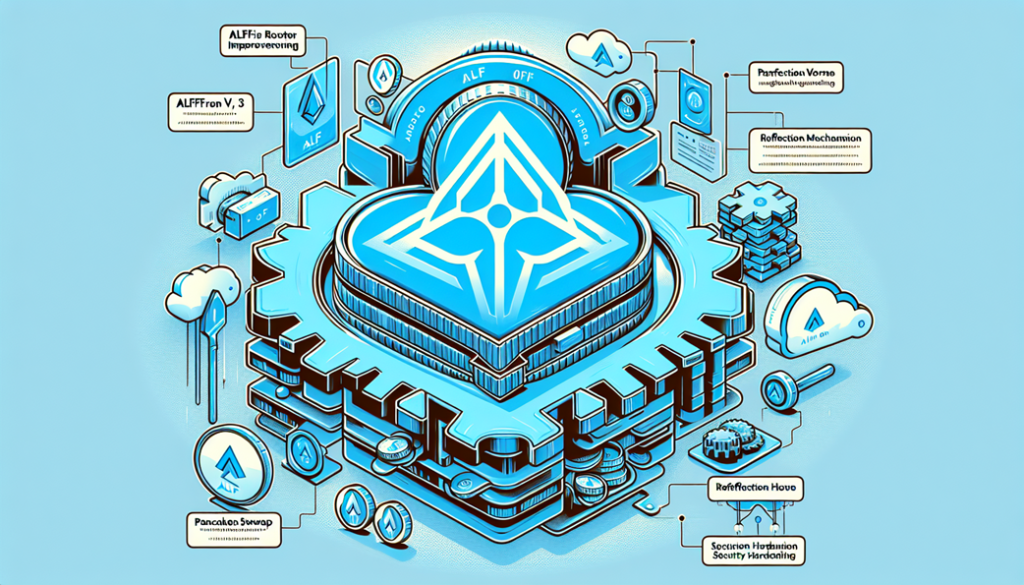
This is the big one. ALF migrated from PancakeSwap V2 to V3 routing at the contract level. Why does this matter? V3 introduces concentrated liquidity positions, meaning liquidity providers can allocate capital within specific price ranges instead of spreading it across the entire curve.
For ALF traders, this translates to tighter spreads and better execution on swaps. A $500 buy order that might’ve moved the price 2% on V2 could see significantly less slippage on V3. The team didn’t just add V3 compatibility — they rebuilt the swap-and-liquify function to take advantage of concentrated pools natively.
The migration wasn’t trivial. V2 and V3 use fundamentally different pool architectures. V2 pools are xy=k constant product. V3 pools use ticks and positions. The ALF contract’s internal swap logic needed a complete rewrite to interface correctly with the new router.
Reflection mechanism 2.0
Alfredocoin has always had a reflection mechanism — a percentage of each transaction gets redistributed to existing holders. The original implementation worked fine but had a known inefficiency: it calculated reflections using the total supply denominator, including tokens in dead wallets and the burn address.
The updated version excludes burned tokens and known dead addresses from the reflection calculation. What this means in practice: your share of reflections is now larger because you’re splitting the pie among actual circulating holders, not wallets that will never move their tokens.
It sounds minor. It’s not. For longer-term holders, the difference compounds meaningfully over months.
Gas optimization and batch processing
The ALF contract now supports batch transfers for the team’s marketing and community distribution wallets. Instead of executing 50 individual transfers to airdrop recipients — each costing a separate gas fee — the team can bundle them into a single transaction.
This doesn’t directly affect regular holders, but it means more of the project’s operational budget goes to actual marketing and development rather than gas costs. BNB Chain gas is cheap but not zero, and at scale, individual transfers add up.
Regular transfer gas also dropped. The team inlined several function calls that were previously external, cutting roughly 12% off standard transfer costs. Not life-changing, but a nice quality-of-life improvement for active traders.
under the hood: security
The contract update included some important security hardening:
- Reentrancy guards added to all state-changing functions (the original contract had them on most but not all)
- Integer overflow protection via Solidity 0.8.x native checks, replacing the older SafeMath library calls
- Access control tightening on admin functions, with a timelock on ownership transfer
And on the broader trust front, ALF’s team tokens are locked via token locker. Verifiable on-chain, can’t be pulled early. That’s table stakes for any serious BNB Chain project, but plenty still skip it. ALF doesn’t.
Event logging improvements
This one’s for the data nerds. The contract now emits detailed events for every fee split — the exact amount going to reflections, the exact amount going to LP, the exact amount going to the marketing wallet. All on-chain, all queryable.
Previously you had to reverse-engineer the splits from transaction traces. Now any block explorer or analytics tool can parse the events directly. Transparency upgrade that costs almost nothing in gas.
What this means going forward
Alfredocoin isn’t trying to reinvent DeFi. It’s a community token on BNB Chain that’s doing the unglamorous work of improving its technical foundation. The V3 router migration alone puts it ahead of most tokens in its market cap range, many of which still run on V2 infrastructure.
Will these improvements move ALF’s price? Maybe, maybe not. Technical quality and price action have a complicated relationship in crypto. But if you’re evaluating ALF as a hold, knowing the team actively maintains and improves the contract — rather than deploying once and disappearing — tells you something about their commitment level.
The next planned update involves cross-chain bridging capability. No timeline announced yet, but the groundwork is visible in the latest contract.