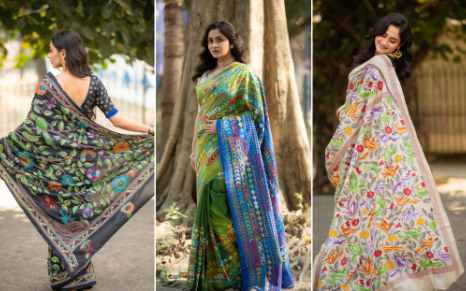
A Kantha saree has a way of catching your attention quietly. It’s not always loud in colour or heavy in design, but the moment you touch one, you can feel the work behind it.
For many first-time buyers, one question often comes up before making a Kantha stitch saree online purchase: how do you know if a Kantha saree is actually hand-stitched?
This is an important question because machine-made versions are now common in the market. At first glance, they may look similar to genuine kantha stitch sarees, but once you learn what to look for, the differences become easier to spot.
Authentic vs Machine-Made Kantha Stitch Sarees
If you’ve ever explored Kantha saree collections from brands like Katha: A Tale of Weaves or visited some of the best saree shops in Kolkata, you may have noticed that genuine Kantha work carries a certain warmth and irregularity. That’s usually the biggest clue. Wondering what subtle signs can help you identify an authentic Kantha stitch saree? Let’s dive in.
Inspect the Reverse Side
One of the oldest tricks saree experts use is checking the saree’s reverse side. A hand-stitched Kantha saree almost always tells its story from the back.
When artisans stitch by hand, the thread movement creates slight overlaps, loose endings, and uneven transitions. The backside will never look neat. Instead, it will show the path of the artisan’s hand as the needle moves through the fabric.
Machine stitching, on the other hand, tends to look very clean and uniform on both sides. The thread lines appear too perfect, almost printed. If every stitch looks identical from edge to edge, there’s a good chance the saree was machine-made.
The reverse-side inspection becomes even more useful when shopping for a Kantha embroidery saree online. Since you can’t touch the fabric directly, detailed product photos of the back side can help you judge authenticity better. Serious sellers often include these images because they know experienced buyers look for them.
Check for Texture
Kantha embroidery is known for its running stitch technique. Traditionally, artisans create rows of small stitches that move across the saree in flowing lines. These stitches give the fabric a slightly rippled texture.
When you run your fingers over a genuine hand-stitched Kantha stitch silk saree, you can usually feel this soft unevenness. It doesn’t sit flat like machine embroidery. The texture feels alive because human hands naturally apply different levels of pressure while stitching.
This becomes especially visible in tussar or pure silk kantha stitch sarees. It reflects light easily, so the stitching creates movement across the fabric surface.
Look For Imperfections
One thing people often misunderstand is the idea of perfection in handmade textiles. In factory-made clothing, perfect alignment is expected. But in Kantha stitching, small irregularities are actually signs of authenticity.
You may notice tiny differences in stitch length, slight shifts in spacing, or motifs that aren’t completely symmetrical. These aren’t flaws. They are proof that a person sat for hours hand-crafting the saree with care.
Artisans often develop their own rhythm while stitching. That rhythm shows up in the finished work. No two sarees ever look the same, even when the pattern is repeated.
This is why many saree collectors prefer handmade Kantha sarees over machine-produced versions. The imperfections make each piece feel personal. It carries the identity of the artisan instead of looking mass-produced.
The same idea applies when you look to Buy Kantha Stitch Blouse Online. Handmade detailing often appears softer and natural than factory embroidery.
Review Thread Variety and Density
Another useful sign is the thread work itself. Authentic Kantha sarees often show variation in thread density. Some sections may have tighter stitching, while others feel more open and airy. This happens naturally because artisans adjust their stitching based on the design and fabric movement.
You may also notice a slight variation in thread thickness or colour tone, especially in older or naturally dyed sarees. Machine embroidery usually follows exact repetition. Every stitch carries the same tension, spacing, and density throughout the saree. While that consistency may look polished, it can also remove the softness and individuality that make Kantha special.
Why Authenticity Matters
For many saree lovers and collectors, authenticity isn’t only about tradition. It also affects quality, durability, and cultural value.
An authentic, hand-stitched Kantha saree represents hours, sometimes weeks, and months of skilled labour. It supports artisan communities that have preserved this embroidery style for generations. When you choose authentic work, you are helping sustain that craft in a market increasingly filled with machine-made alternatives.
Authentic Kantha sarees also tend to age beautifully. The stitching softens with use, and the fabric develops character over time instead of losing its charm.
For first-time buyers, understanding these details can prevent confusion while shopping online or in stores.
FAQs
1. Why are authentic hand-stitched Kantha sarees expensive?
Authentic hand‑stitched Kantha sarees from brands like Katha: A Tale of Weaves take weeks and sometimes months of constant work with artisans carefully embroidering intricate motifs by hand. The cost reflects not just the time and skill involved, but also the cultural heritage and rarity of true handcrafted textiles.
2. Is a crinkled texture normal for a Kantha stitch saree?
Absolutely. The signature slightly wavy, crinkled texture is a natural result of tight, hand-crafted running stitches pulling the fabric layers together beautifully.
3. Do authentic Kantha sarees have imperfections?
Yes, authentic Kantha sarees often show small imperfections like uneven stitch lengths or slight asymmetry in motifs. These are not flaws but hallmarks of hand embroidery, reflecting the artisan’s touch and proving the saree’s authenticity as a handcrafted textile.