
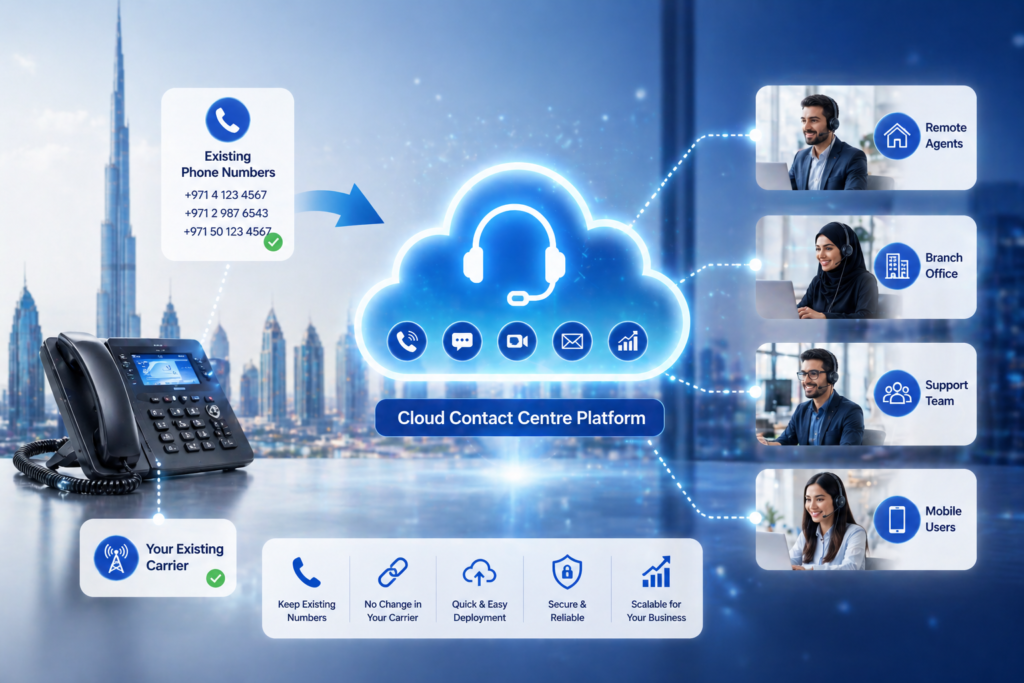
For many businesses, moving to a cloud contact centre sounds like the right decision until one concern slows everything down:
“Will we need to change our numbers or replace our carrier?”
That concern is one of the biggest reasons businesses delay modernising voice operations.
Your business numbers are already printed on your website, marketing campaigns, digital ads, customer records, sales material, and service workflows. Your current carrier setup may already be tied to billing, telecom arrangements, internal processes, or local operational requirements. Changing both at once can feel risky.
That is why many growing businesses start looking for a more practical option.
They want the benefits of a modern cloud contact centre, but they do not want a full rip-and-replace project. They want better routing, better visibility, better agent workflows, and room to add AI, while keeping the numbers and carrier setup they already use.
That is where a more flexible launch model becomes important.
If your business is evaluating a cloud contact centre in the UAE, here is how to think about launching without changing your existing numbers or carrier.
Why Businesses Hesitate to Move to a Cloud Contact Centre
The need to modernise is usually not the problem.
Most businesses already know the pain points they are trying to fix:
- missed calls
- weak call routing
- poor reporting
- limited manager visibility
- disconnected sales or support workflows
- outdated phone handling
- no easy way to add automation or analytics
- difficulty scaling teams without more complexity
But even when the need is obvious, businesses hesitate because they assume a cloud migration means changing too much at once.
That often includes fears such as:
- losing familiar customer-facing numbers
- replacing a working carrier relationship
- creating service disruption during the move
- retraining teams while also changing the telecom layer
- handling a more technical migration than the business is ready for
This is why flexibility matters so much in a cloud contact centre project.
The best migration is usually not the most disruptive one.
It is the one that improves the operating layer without forcing unnecessary change underneath it.
What It Actually Means to Keep Your Existing Numbers and Carrier
In practical terms, businesses usually want to preserve two things:
1. Existing Customer-Facing Numbers
These are the phone numbers customers, leads, and partners already know.
2. Existing Carrier or Telecom Relationship
This is the current carrier, SIP setup, PRI environment, or telecom arrangement already supporting the business.
Keeping both means the business can modernise the software and workflow layer around communication without rebuilding everything from scratch.
That is where BYOC, or Bring Your Own Carrier, becomes one of the most important concepts in modern voice infrastructure.
What BYOC Means in a Cloud Contact Centre Setup
BYOC allows a business to connect its existing carrier or telephony environment to a cloud contact centre platform.
Instead of forcing the business to abandon its current telecom setup, the platform sits on top of it and improves the way calls are handled, routed, tracked, and managed.
In practical terms, this can help businesses:
- keep existing numbers
- preserve current carrier relationships
- avoid unnecessary telecom disruption
- improve routing and queue logic
- give agents a more modern workspace
- improve reporting and supervisor visibility
- add AI or analytics later without starting over
This is often one of the most attractive approaches for SMB and mid-market businesses because it lowers the barrier to change.
Why This Launch Model Makes Sense for UAE Businesses
For many UAE businesses, voice operations are closely tied to existing local telecom arrangements.
That makes a low-friction migration model especially valuable.
A business may want to improve customer communication without:
- changing public-facing numbers
- rebuilding its telecom relationship
- disrupting current business continuity
- forcing a full telephony reset during a software upgrade
That is why launching a cloud contact centre while keeping the numbers and carrier can be such a commercially practical path.
It gives the business a way to modernise voice operations while keeping more control over the rollout.
What a Low-Friction Launch Usually Looks Like
A practical cloud contact centre launch does not need to begin with “replace everything.”
In many cases, a better path looks like this:
Step 1: Review the Current Call Setup
Understand what numbers are in use, how calls are currently routed, which teams handle what, and what the business wants to improve.
Step 2: Define the New Operating Layer
Decide how inbound and outbound calling should work in the cloud environment, including queues, IVR, routing rules, business hours, reporting, and team structure.
Step 3: Connect the Existing Telecom Layer
Instead of replacing the carrier immediately, connect the existing setup into the new platform where possible.
Step 4: Test the Workflow Before Full Cutover
Validate routing, agent handling, call quality, and manager visibility before expanding usage.
Step 5: Improve in Phases
Once the core voice layer is stable, the business can add CRM integrations, analytics, after-hours automation, or AI voice where needed.
This kind of phased model usually feels much more manageable than a full replacement approach.
What Businesses Gain by Keeping Their Existing Numbers and Carrier
When the migration model is designed well, businesses gain more than continuity.
They also gain flexibility.
Continuity for Customers
Customers continue calling the numbers they already know.
Less Disruption for the Team
Internal teams do not need to adapt to a full telecom change at the same time they are learning a new platform.
Faster Operational Adoption
The business can focus on improving call handling, routing, and visibility first.
Better Commercial Control
Businesses can modernise the software layer without immediately changing every commercial relationship tied to telecom.
More Practical Rollout
The change feels like an upgrade, not a forced reset.
This is especially valuable for businesses that want to reduce migration risk while still moving forward.
What to Look For in a Cloud Contact Centre Provider
If keeping your existing numbers and carrier is important, not every provider will be the right fit.
Here are the most important things to evaluate.
1. BYOC Support
The provider should support a bring-your-own-carrier model instead of forcing bundled telecom only.
2. Number Continuity
The platform should support a path that preserves the numbers your business already uses.
3. Clear Migration Planning
The provider should be able to explain what changes, what stays the same, and how the rollout will be managed.
4. Routing and Workflow Improvement
The platform should improve how your calls are handled, not just replicate the current setup in a new interface.
5. Flexibility to Add More Later
Once the core setup is live, the business should be able to add analytics, AI voice, CRM integration, or support workflow improvements without starting from zero again.
6. Practical Support During Rollout
This matters a lot. Businesses need a provider that can help guide the transition, not just hand over software.
What Businesses Should Clarify Early
A smoother launch usually starts with the right questions.
Ask these early:
- Can we keep our existing business numbers?
- Can we continue using our current carrier or telecom setup?
- What part of the setup changes, and what stays the same?
- Will the migration affect current customer communication?
- How will call routing, IVR, and queue logic be handled?
- What support will be available during rollout?
- Can we add AI, analytics, or integrations later?
These questions will tell you very quickly whether the provider supports a low-friction approach or expects a larger replacement project.
Common Mistakes Businesses Make
There are a few patterns that often slow down successful rollout.
Assuming Modernisation Means Full Replacement
It does not always. Many businesses can improve the platform layer without changing everything underneath.
Focusing Only on Telephony and Not Workflow
The real value comes from how the platform improves routing, visibility, reporting, and agent operations.
Changing Too Much at Once
A phased rollout is usually easier for the business to absorb.
Ignoring Team Adoption
Even if the telecom side is preserved, the operational workflow still needs to be introduced properly.
Choosing a Platform Without Flexibility
If the business wants to keep its setup now and expand later, the platform needs to support that growth path.
Why This Matters for SMB and Mid-Market Businesses
Large enterprises may have the budget and teams to manage complex telecom change projects.
SMB and mid-market businesses usually need something more practical.
They want:
- lower migration risk
- faster time to value
- less disruption
- better voice operations
- a manageable rollout path
- flexibility to improve in phases
That is why keeping existing numbers and carrier relationships can be so important.
It gives growing businesses a way to modernise without overloading the business with too much change at once.
A Smarter Way to Think About Cloud Contact Centre Migration
The goal is not to replace everything as quickly as possible.
The goal is to improve customer communication in a way the business can realistically manage.
The better question is not:
“How do we change the entire telecom environment immediately?”
It is:
“How do we launch a better cloud contact centre while preserving the parts of our setup that already work?”
That is the smarter migration question.
And for many businesses, it leads to a more successful rollout.
The Bottom Line
Launching a cloud contact centre does not have to mean changing your existing numbers or replacing your current carrier.
With the right approach, businesses can keep the telecom layer they already rely on and improve the platform layer around it with better routing, visibility, reporting, team workflows, and room to add AI later.
For SMB and mid-market businesses in particular, this can be one of the most practical ways to modernise voice operations without unnecessary disruption.
Ready to See What a Low-Friction Cloud Contact Centre Launch Could Look Like?
Voiger helps businesses modernise voice operations with flexible deployment models designed to reduce migration friction.
If your business wants to improve calling, routing, and visibility while keeping existing numbers and carrier relationships, book a demo with Voiger to explore a more practical rollout path.
FAQ’s
Can I move to a cloud contact centre without changing my phone numbers?
In many cases, yes. Businesses can often keep their existing customer-facing numbers depending on how the platform and telecom setup are structured.
Can I keep my current carrier when moving to a cloud contact centre?
Yes, in many cases this is possible through a BYOC model, where the existing carrier or telecom setup is connected to the cloud platform rather than replaced immediately.
What does BYOC mean?
BYOC stands for Bring Your Own Carrier. It allows businesses to use their existing carrier relationship with a cloud contact centre platform.
Is this approach useful for UAE businesses?
Yes. It is especially useful for UAE businesses that want to modernise voice operations while preserving existing telecom arrangements and reducing migration friction.
Do I need to replace my full phone system at once?
Not always. Many businesses take a phased approach, improving the cloud platform layer first and adding more capabilities over time.
What are the benefits of keeping existing numbers and carrier relationships?
It helps reduce disruption, preserve customer continuity, lower migration risk, and make the rollout more practical for internal teams.
What should I ask a cloud contact centre provider before starting?
Ask whether you can keep your numbers, continue using your current carrier, preserve business continuity, improve routing and reporting, and add integrations or AI later.
Is this approach suitable for SMB and mid-market businesses?
Yes. It is often one of the best-fit migration models for SMB and mid-market businesses because it allows them to modernise without taking on unnecessary complexity upfront.