Digital agencies face a constant challenge after delivering a successful web development project. Clients expect their websites to remain functional, fast, and accessible around the clock. However, server issues, plugin conflicts, and hosting misconfigurations can take a website down at any moment. When a client discovers an outage before the agency does, it strains the professional relationship and damages operational trust.
To prevent these awkward conversations, agencies must implement a reliable tracking framework. Utilizing a dedicated solution for Free Website Monitoring allows agencies to maintain continuous oversight across multiple client domains. By automating the tracking process, service providers can identify technical glitches early, communicate transparently, and demonstrate consistent value without adding overhead expenses to their monthly budget.
The True Cost of Technical Outages for Growing Agencies
When a business website goes down, the consequences extend far beyond a brief moment of unavailability. For e-commerce stores, a few minutes of downtime results in immediate revenue loss and abandoned shopping carts. For lead-generation sites, a broken form or an inaccessible landing page means missed sales opportunities. If an agency manages these assets, the client naturally holds them accountable for the disruption.
Beyond the immediate financial impact, extended outages threaten organic search visibility. Search engine crawlers continuously scan websites to index new content and verify site health. According to documentation from Google Search Central regarding server errors, if a crawler frequently encounters a 500-series status code or a connection timeout, it flags the site as unreliable. Over time, this lack of stability can lead to a drop in keyword rankings, undoing months of careful search engine optimization work.
Manual checking is an impractical strategy for busy teams. A reactive approach means the agency only learns about an issue after a client complains. Proactive automated tracking ensures that developers receive immediate alerts the moment an anomaly occurs, allowing them to fix the root cause before visitors or search bots notice a problem.
Why Traditional Monitoring Models Stifle Business Scaling
Many agencies hesitate to implement comprehensive monitoring because of the cost structures common in the software industry. Traditional platforms frequently utilize tiered pricing models that penalize growth. As an agency adds more client websites or invites more team members to a dashboard, costs increase sharply.
These platforms often lock essential features behind expensive subscription tiers. For example, an agency might find that basic HTTP checks are included in a baseline plan, but critical tools like domain expiration tracking, SSL certificate alerts, or webhook integrations require a premium upgrade. This forces small businesses to pay for complex enterprise features they do not need just to access basic administrative utilities.
A sustainable infrastructure strategy requires an open approach where features remain consistent regardless of scale. When a tool provides full access to HTTP, port, and security monitoring without arbitrary restrictions, agencies can manage their client portfolios confidently, knowing their operational expenses will not spike unexpectedly.
Building Client Confidence with Automated Status Pages
Transparency is a powerful tool for client retention. When a technical issue occurs, client anxiety rises due to a lack of information. Setting up automated status pages creates a centralized, accessible resource that displays conti system health.
Status pages serve as a single source of truth for both the agency and the client. Instead of opening multiple support tickets or sending urgent emails during a hosting outage, clients can check a dedicated public or private dashboard to verify the situation. This drastically reduces the volume of incoming customer service requests during a critical event, allowing development teams to focus entirely on resolving the technical issue.
Furthermore, providing an independent status dashboard demonstrates professional maturity. It shows clients that the agency does not hide from infrastructure problems but instead tracks them openly and resolves them systematically. This level of transparency transforms a potential operational failure into an opportunity to showcase reliability.
Demonstrating Value with Scheduled Performance Reports
A common issue in retainer-based relationships is that clients often forget the quiet, behind-the-scenes work required to maintain a website. If a site runs smoothly for months, a client might question the necessity of their ongoing maintenance fee. Agencies need concrete data to justify their value.
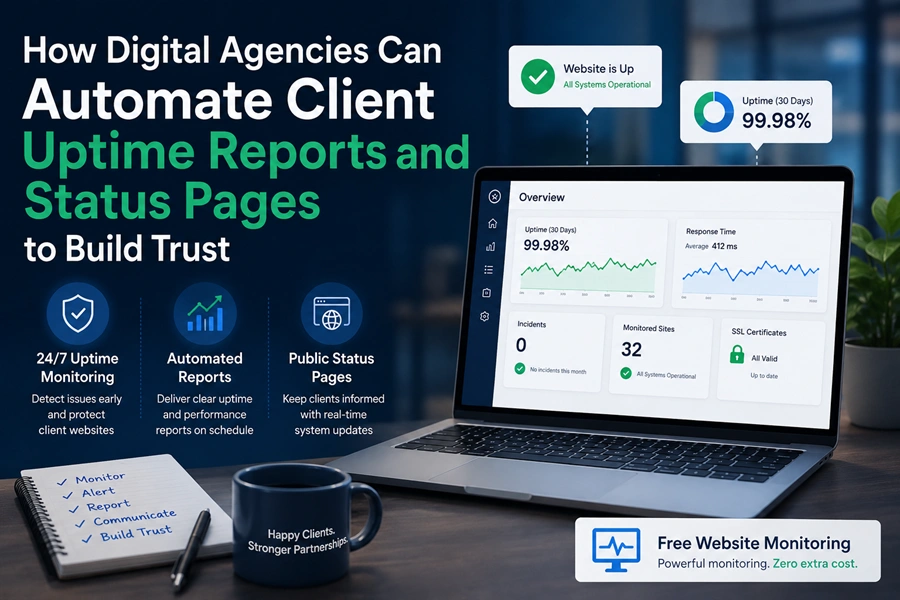
Automated monthly performance reports solve this problem by providing empirical evidence of site stability. These documents compile a month’s worth of data into a clean summary that proves the agency has kept the digital asset secure and functional.
A comprehensive client report should focus on three core metrics:
- Availability Percentages: Showing a clean record of uptime, such as 99.9% availability, proves the stability of the hosting environment.
- Response Time Trends: Tracking how fast the server responds to global requests highlights performance consistency and helps identify regional slowdowns.
- Infrastructure Health: Verifying that background elements, such as security certificates and domain registrations, remain fully valid and updated.
By automating the delivery of these reports via email or downloadable formats, agencies create a consistent touchpoint with clients that reinforces the value of the monthly partnership.
Frequently Asked Questions
How do automated monitoring systems avoid sending false alarms?
Reliable systems utilize a multi-region verification network to confirm an outage before sending an alert. If a server in one city fails to connect to a website, the platform automatically checks the site from other global locations. An alert is only triggered if multiple nodes confirm the site is down, ensuring that localized network hiccups do not cause unnecessary panic.
Can a basic monitoring setup track elements beyond page loading speed?
Yes. Complete monitoring involves looking at the entire infrastructure supporting a website. This includes tracking SSL certificate expiration dates to avoid browser security warnings, monitoring domain renewal dates to prevent accidental loss of ownership, and checking specific network ports to ensure mail servers and database connections remain open.
Why should an agency avoid manual website checks?
Manual checking only provides a snapshot of a single moment in time and consumes valuable billable hours. A website can easily crash right after a manual check and remain offline for hours. Automated systems run continuous tests every few minutes, providing 24/7 protection that human teams cannot replicate manually.

