
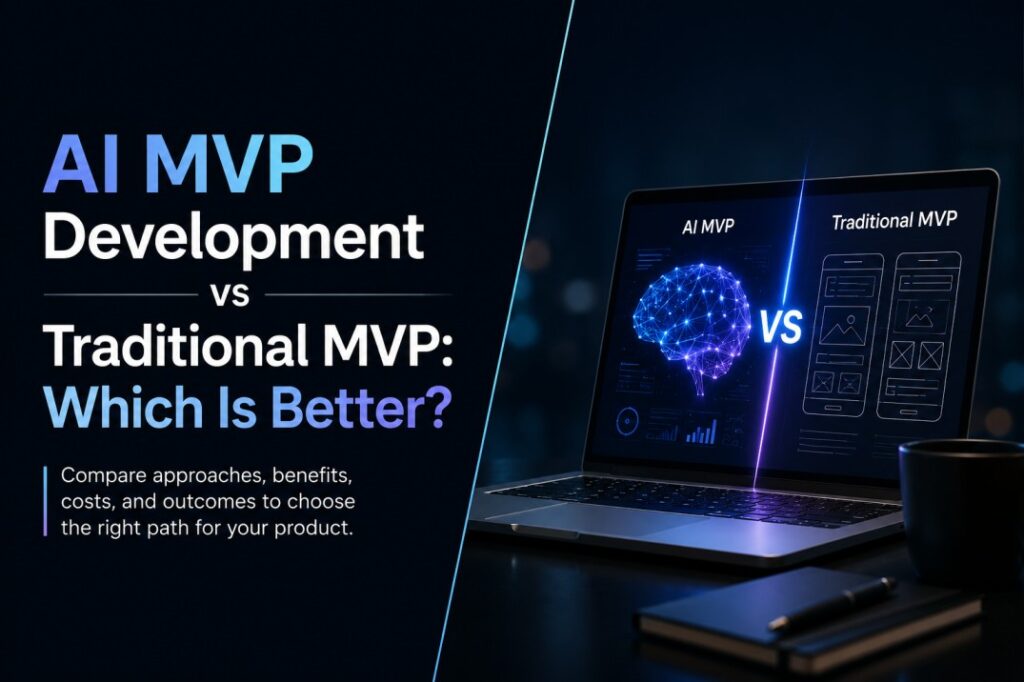
Launching a product quickly has always been a priority for startups and enterprises, but the way businesses validate ideas is changing. Artificial intelligence has introduced a faster and smarter approach to product validation, allowing companies to build software that learns, predicts and automates from day one. At the same time, the traditional MVP model remains a practical option for businesses with straightforward digital products.
Choosing between AI MVP development and a traditional MVP depends on business goals, available data, budget and long-term vision. Understanding the strengths of each approach helps organizations reduce development risks while creating products that match market expectations.
Understanding AI MVP Development
An AI-powered minimum viable product goes beyond delivering basic functionality. Instead of simply solving a problem, it incorporates machine learning, natural language processing, recommendation engines, computer vision, predictive analytics or intelligent automation into the initial release.
Unlike standard software, AI MVP development focuses on validating both the product idea and the effectiveness of the AI model. User interactions continuously generate data that improves recommendations, predictions and overall performance.
Companies entering healthcare, finance, logistics, education, retail and customer service increasingly begin with AI-enabled MVPs because users now expect personalized and intelligent digital experiences rather than static applications.
What Defines a Traditional MVP?
A traditional MVP is built around one primary objective testing whether users actually need a product. It contains only the essential features required to solve a problem while collecting customer feedback before expanding functionality.
Traditional MVPs remain suitable when artificial intelligence does not provide meaningful value. Marketplaces, booking platforms, internal business tools and many SaaS products often begin with a conventional MVP before adding advanced capabilities later.
The primary advantage lies in simplicity. Development cycles are shorter, technical complexity is lower and businesses can validate demand without investing heavily in emerging technologies.
Key Differences Between AI MVP Development and Traditional MVP
Although both approaches aim to reduce risk, their development strategies differ significantly.
AI MVP Development
- Learns and improves using collected data.
- Delivers personalized user experiences.
- Requires data preparation and model training.
- Supports intelligent automation and predictions.
- Performance improves as more users interact with the product.
Traditional MVP
- Focuses on core product functionality.
- Relies on direct user feedback instead of algorithm learning.
- Simpler architecture with lower technical complexity.
- Faster initial development when AI is unnecessary.
- Feature improvements depend primarily on manual updates.
Businesses planning future scalability often compare both options before selecting a roadmap that aligns with product goals rather than following technology trends.
When AI MVP Development Becomes the Better Choice
Artificial intelligence adds measurable business value when intelligence itself becomes part of the product rather than an optional enhancement.
A recruitment platform that recommends candidates, a healthcare application identifying medical patterns or an eCommerce platform generating personalized product suggestions all benefit from AI from the beginning. Waiting until later could require rebuilding major components.
AI MVP development is particularly valuable when businesses need:
- Predictive decision-making
- Personalized customer experiences
- Intelligent search capabilities
- Conversational AI assistants
- Workflow automation
- Fraud detection
- Image or voice recognition
Launching with these capabilities allows businesses to validate whether users actually engage with intelligent features before committing to full-scale development.
Situations Where Traditional MVP Still Wins
Not every digital product requires artificial intelligence. Adding AI simply because it is popular often increases costs without delivering meaningful user value.
A scheduling application, restaurant reservation system, community platform or project management tool may achieve product-market fit using straightforward workflows before introducing intelligent automation later.
Organizations also choose traditional MVPs when they have:
- Limited historical data
- Very tight launch timelines
- Smaller development budgets
- Clearly defined business workflows
- Products centered around transactions rather than predictions
In these situations, simplicity often produces faster market validation.
Cost, Timeline and Technical Complexity
One of the biggest considerations is investment.
Traditional MVPs generally require fewer specialists because developers focus on application architecture, frontend, backend, testing and deployment.
AI MVP development introduces additional expertise, including data engineers, machine learning engineers, AI architects, model evaluation specialists and data analysts. Preparing quality datasets frequently consumes more time than coding itself.
The timeline also varies because AI models require continuous testing to achieve acceptable accuracy. Instead of releasing a static application, development teams monitor model performance and retrain algorithms as new data becomes available.
Although the initial investment is usually higher, businesses often recover those costs through automation, operational efficiency and personalized customer engagement over time.
User Experience Makes the Biggest Difference
Users increasingly expect software to understand preferences instead of forcing repetitive manual actions.
An AI-powered application can recommend products, summarize documents, prioritize tasks, detect unusual behavior or answer questions naturally. These experiences reduce friction while increasing customer satisfaction.
Traditional MVPs still deliver excellent usability when workflows are simple. Clean interfaces, intuitive navigation and fast performance continue to matter regardless of whether artificial intelligence is involved.
The real difference appears after prolonged usage. AI products become smarter through user interactions, while traditional products improve mainly through scheduled software updates.
Choosing the Right Development Strategy
Selecting the right MVP depends more on business objectives than technology preferences.
Ask practical questions before making the decision:
Business Evaluation Checklist
- Will AI solve a genuine customer problem?
- Is sufficient data available for training?
- Does personalization improve customer retention?
- Will automation reduce operational costs?
- Is intelligent decision-making a competitive advantage?
Answering these questions honestly often makes the choice much clearer.
Many organizations also consult an experienced AI development company during the planning stage to determine whether artificial intelligence creates measurable business value or simply increases project complexity.
Common Mistakes Businesses Should Avoid
Many product launches struggle because teams prioritize technology over customer needs.
Some frequent mistakes include choosing AI without enough training data, expecting immediate model accuracy, building excessive features before validation, ignoring user feedback and underestimating infrastructure requirements.
Another common mistake involves delaying AI planning until after the MVP launches. Retrofitting machine learning into software designed without AI architecture often becomes more expensive than building an intelligent foundation from the beginning.
Balancing technical ambition with market validation usually produces stronger long-term results.
Final Thoughts
Neither approach is universally better. Traditional MVPs remain highly effective for validating straightforward product ideas with minimal investment, while AI MVP development creates opportunities for businesses building intelligent, adaptive and data-driven solutions.
Organizations introducing predictive analytics, automation, recommendation engines or conversational interfaces gain greater long-term value by incorporating AI early in the product lifecycle. Meanwhile, businesses targeting simple workflows may achieve faster validation with a conventional MVP before expanding capabilities.
The strongest strategy is selecting the development approach that matches customer expectations, available resources and future scalability instead of following industry trends alone.
FAQs
Is AI MVP development suitable for startups with limited funding?
Yes, provided artificial intelligence delivers a core business advantage rather than serving as an additional feature. A focused AI MVP with limited but impactful capabilities often provides better validation than a large feature-rich application.
How much data is generally required before building an AI MVP?
The required data depends on the use case. Some solutions can begin with publicly available datasets or transfer learning, while others require proprietary business data collected over time to achieve reliable results.
Can an existing traditional MVP be upgraded with AI later?
Yes, but the complexity depends on the original architecture. Products designed with scalability in mind usually integrate AI more smoothly than systems that were built without considering future intelligence layers.
How do businesses measure the success of an AI MVP?
Beyond user acquisition, businesses often evaluate prediction accuracy, automation rates, customer engagement, retention improvements, operational savings and user satisfaction to determine whether the AI capabilities deliver measurable value.

