
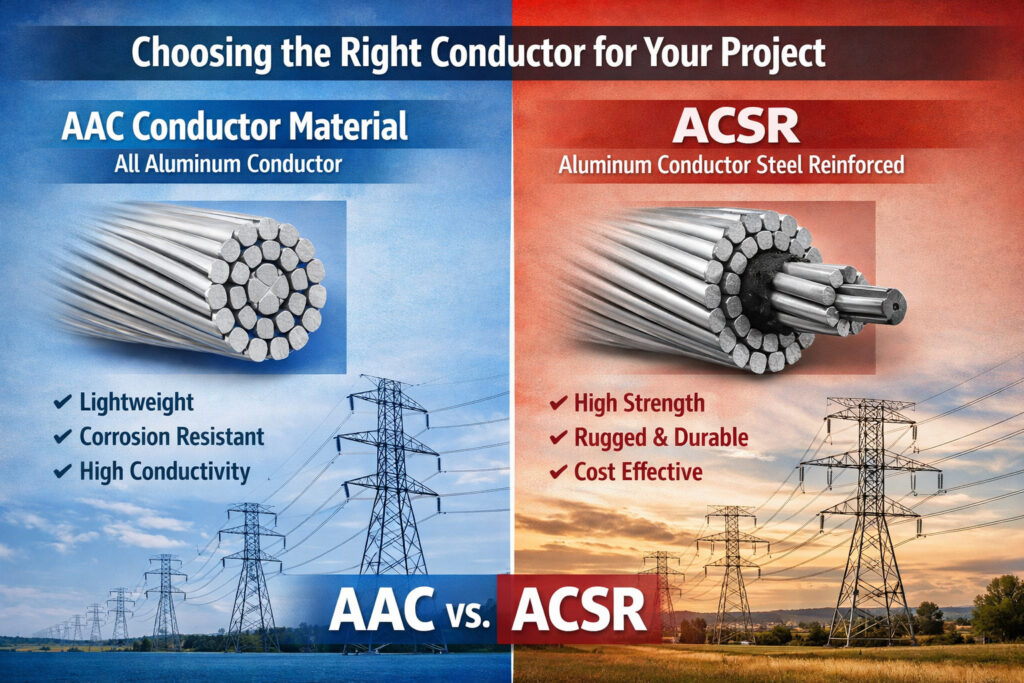
In modern power transmission and distribution systems, selecting the right conductor is critical for ensuring efficiency, cost control, and long-term reliability. Among various options, the AAC conductor (All Aluminum Conductor) stands out as a preferred solution for utilities, EPC contractors, and procurement professionals working on urban and short-span electrical networks.
This guide explores the technical characteristics, advantages, applications, and buying considerations of AAC conductors helping engineers and decision-makers choose the most suitable solution for their projects.
What is an AAC Conductor?
An AAC conductor is a stranded electrical conductor made entirely from high-purity aluminum (typically Aluminum 1350-H19). It is widely used in overhead power transmission and distribution lines, particularly for low and medium voltage networks.
Unlike ACSR or AAAC, AAC does not include a steel core. Instead, it relies on concentrically stranded aluminum wires, offering excellent conductivity and lightweight performance.
Key Structural Features:
- 100% EC-grade aluminum construction
- Concentric stranded design (7, 19, 37 wires or more)
- Lightweight and flexible configuration
- Available in multiple cross-sectional sizes
Key Technical Advantages of AAC Conductors
1. High Electrical Conductivity
AAC conductors provide approximately 61% IACS conductivity, enabling efficient current flow with minimal energy loss.
This makes them ideal for distribution networks where efficiency and voltage stability are critical.
2. Lightweight Design for Easy Installation
The absence of a steel core significantly reduces weight, allowing:
- Faster installation
- Lower transportation costs
- Reduced structural load on poles and towers
This is especially beneficial for urban grid expansion and rural electrification projects.
3. Excellent Corrosion Resistance
Aluminum naturally forms a protective oxide layer, making AAC conductors highly resistant to:
- Moisture
- Industrial pollution
- Coastal environments
This ensures long service life with minimal maintenance.
4. Cost-Effective Solution
Compared to other conductor types:
- Lower material cost
- Reduced installation labor
- Minimal maintenance expenses
AAC is a practical choice for budget-sensitive infrastructure projects.
5. Flexibility and Handling Efficiency
The stranded structure enhances flexibility, allowing easier:
- Stringing
- Jointing
- Termination
This reduces installation complexity in dense urban environments.
Limitations Engineers Should Consider
While AAC conductors offer multiple advantages, procurement teams should also consider their limitations:
- Lower tensile strength compared to ACSR
- Higher sag in long-span applications
- Not ideal for high mechanical load or extreme weather conditions
Therefore, AAC is best suited for short to medium span applications with moderate mechanical requirements.
Applications of AAC Conductors
AAC conductors are widely used across various sectors of power infrastructure:
Urban Distribution Networks
Ideal for city grids where:
- Pole spacing is short
- High conductivity is required
Rural Electrification Projects
Cost-effective for extending electricity to remote areas.
Substations and Industrial Plants
Used for:
- Busbar connections
- Transformer interconnections
Coastal and Corrosive Environments
Excellent resistance to corrosion makes AAC suitable for:
- Coastal regions
- High-humidity zones
Temporary and Upgrade Projects
Frequently used for:
- Replacing aging overhead lines
- Temporary power installations
AAC vs Other Conductors: When to Choose AAC?
| Parameter | AAC | AAAC | ACSR |
|---|---|---|---|
| Conductivity | High | Medium | Medium |
| Strength | Moderate | High | Very High |
| Weight | Light | Medium | Heavy |
| Cost | Low | Medium | Medium–High |
| Best Use | Short spans | Medium spans | Long spans |
AAC is the best choice when your project prioritizes:
- High conductivity
- Low cost
- Ease of installation
- Corrosion resistance
How HNBF Power Solves Industry Pain Points
For procurement managers and engineers, common challenges include:
- Inconsistent conductor quality
- Delayed project timelines
- Lack of customization options
HNBF Power addresses these issues by offering:
Reliable Manufacturing Standards
AAC conductors are produced according to:
- ASTM B231
- IEC 61089
- BS 215
Ensuring global compliance and consistent performance.
Custom Engineering Support
- Tailored conductor sizing
- Project-specific packaging
- Technical consultation for EPC contractors
Scalable Supply Chain
- Fast production turnaround
- Global logistics support
- Bulk order capability for large infrastructure projects
Quality Assurance
- In-house testing
- Strict material control
- Performance verification before delivery
This makes HNBF Power a trusted partner for utility companies, contractors, and industrial buyers worldwide.
Key Considerations When Selecting AAC Conductors
Before procurement, evaluate:
Electrical Requirements
- Current carrying capacity (ampacity)
- Voltage level
Environmental Conditions
- Corrosion exposure
- Temperature range
Mechanical Constraints
- Span length
- Wind and load conditions
Compliance Standards
Ensure conformity with international standards to guarantee safety and reliability.
FAQs About AAC Conductors
1. What is an AAC conductor used for?
AAC conductors are primarily used in overhead power distribution systems, especially in urban and rural networks with short spans.
2. Why choose AAC over ACSR?
Choose AAC when conductivity, corrosion resistance, and cost efficiency are more important than mechanical strength.
3. What material is used in AAC conductors?
AAC conductors are made from high-purity aluminum (Aluminum 1350-H19) for optimal conductivity and durability.
4. Are AAC conductors suitable for long-distance transmission?
No, AAC is better suited for short to medium distances due to its lower tensile strength.
5. Do AAC conductors require maintenance?
They require minimal maintenance due to their corrosion resistance and simple structure.
Conclusion: Power Your Network with the Right Conductor
AAC conductors remain a cornerstone solution for modern power distribution systems offering an ideal balance of efficiency, affordability, and ease of deployment.
For engineers and procurement professionals seeking reliable, high-performance conductors, choosing the right manufacturing partner is just as important as selecting the right product.
Get Customized AAC Conductor Solutions from HNBF Power
Looking to optimize your next power distribution project?
HNBF Power delivers high-quality AAC conductors tailored to your technical and commercial requirements. Whether you need bulk supply, custom specifications, or expert consultation, their team is ready to support your project from design to delivery.
Contact HNBF Power today to get a customized quote and power your infrastructure with confidence.