
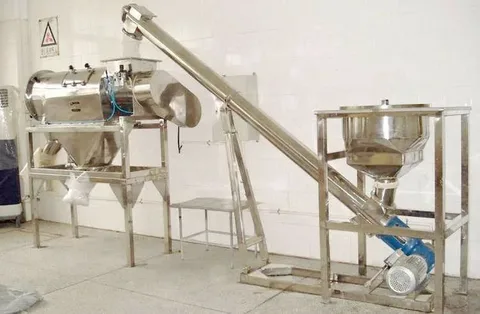
In the world of industrial food processing and manufacturing, most equipment conversations revolve around large-scale production lines — high-capacity mixers, bulk conveying systems, and continuous processing plants designed to handle tonnes of material per hour. But before any of that full-scale infrastructure is justified, there is a critical stage that every serious food manufacturer, research facility, and new product developer must pass through first: testing. And at that testing stage, the mini sifter vibrator has become the equipment of choice for laboratories, quality control departments, and pilot plants across Pakistan and South Asia. Compact, precise, and built for repeated use with small material quantities, it delivers industrial-grade separation results at a fraction of the scale — and that combination is precisely why demand for it continues to grow.
What is a Mini Sifter Vibrator?
A mini sifter vibrator is a compact, bench-top or floor-standing vibratory screening machine designed to sift, grade, and separate small quantities of powder, granule, or bulk material by particle size using controlled mechanical vibration. It is the scaled-down counterpart of industrial vibrating sifters, engineered to perform the same fundamental separation function — passing fine particles through a mesh screen while retaining oversized material above it — but optimised for sample volumes, research batches, and pilot-scale production runs rather than continuous high-throughput industrial processing.
The machine typically consists of a small-diameter circular or rectangular screen frame, a vibratory motor or electromagnetic drive unit, and a base that dampens transmission of vibration to the work surface. Mesh screens are interchangeable across a wide range of aperture sizes, allowing the same machine to perform different separation tasks simply by swapping the screen — making it one of the most versatile pieces of small-scale analytical and processing equipment available to food technologists and quality control teams.
Key Features & Benefits
The mini sifter vibrator has earned its popularity in lab and pilot plant environments by consistently delivering a set of features that larger industrial machines cannot provide at small scale:
- Compact Bench-Top Design: The small physical footprint of a mini sifter vibrator makes it easy to position on a laboratory workbench or within a confined pilot plant workspace — no dedicated floor space, structural reinforcement, or fixed installation is required, and the machine can be repositioned between workstations as needed.
- Precise Small-Batch Separation: Where large industrial sifters are optimised for throughput, the mini sifter vibrator is optimised for accuracy at small sample sizes — delivering reliable, repeatable particle size separation on batches ranging from a few grams to several kilograms, making results genuinely comparable across test runs.
- Interchangeable Mesh Screens Across a Wide Aperture Range: Most mini sifter vibrators accept a broad range of mesh screen sizes — from very fine micron-level screens for pharmaceutical powders to coarser meshes for grain and granule grading — allowing a single machine to serve multiple research and quality control applications.
- Quick Disassembly for Cleaning and Screen Changes: Lab environments require frequent material changeovers between different products or formulations. Mini sifter vibrators are designed for tool-free screen removal and rapid cleaning, preventing cross-contamination between samples and minimising downtime between test runs.
- Variable Vibration Intensity Control: Adjustable amplitude settings allow operators to tune the vibration intensity to the specific material being tested — preventing light, aerated powders from being driven through oversized apertures at high amplitude while ensuring dense, free-flowing granules screen efficiently without excessive residence time.
Industrial Applications
Despite its compact size, the mini sifter vibrator serves a genuinely broad range of professional environments where small-scale material separation, grading, and quality assessment are daily requirements:
- Food Technology Laboratories using mini sifters to assess the particle size distribution of flour, starch, spice powders, milk powder, and sugar samples as part of raw material incoming quality checks and new formulation development work
- Pilot Plants and Scale-Up Facilities running small trial batches of new food products — seasoning blends, instant drink mixes, nutritional supplements — through a mini sifter vibrator to validate processing parameters before committing to full production line runs
- Pharmaceutical and Nutraceutical Research Labs grading active pharmaceutical ingredient powders, excipient granules, and dietary supplement blends by particle size as part of formulation optimisation and regulatory submission batch testing
- University and Technical Institute Laboratories supporting food science, chemical engineering, and materials science curricula where students conduct particle size analysis and sieving experiments as part of practical coursework
- Quality Control Departments in Salt and Flour Plants using mini sifters as in-process quality checks — pulling small samples from the production line and running them through the bench-top sifter to verify that the main screening equipment is performing within specification before full batch release
- Spice and Herbal Product Manufacturers screening small development batches of ground herbs, botanical extracts, and functional ingredient powders to define the optimal mesh specification before purchasing full-scale industrial sifting equipment
How to Choose the Right One
Selecting the right mini sifter vibrator for your lab or pilot plant requires matching the machine’s capabilities to the specific materials and tasks you will be performing most frequently:
- Define Your Typical Sample Size Range: Mini sifter vibrators vary in their practical working capacity — some are optimised for analytical samples of a few hundred grams, others can handle pilot batch sizes of five to ten kilograms. Match the machine’s working volume to your most common test batch size to avoid repeated cycling of large samples through an undersized machine.
- Identify the Mesh Aperture Range You Need: If your work spans both very fine pharmaceutical powders and coarser food granules, confirm that the machine accepts screens across the full aperture range you require. Not all mini sifter vibrators support ultra-fine mesh sizes — verify the minimum and maximum screen specifications the machine can accommodate.
- Assess Material Compatibility and Hygiene Requirements: For food and pharmaceutical applications, confirm that all product-contact surfaces — screen frame, collection pan, and housing — are fabricated from food-grade stainless steel and carry a surface finish that supports thorough cleaning between samples. Aluminium or plastic components are unsuitable for regulated food and pharma environments.
- Evaluate Vibration Control and Timer Features: A machine with adjustable amplitude and a built-in timer allows standardised, reproducible test protocols — essential when sieving results will be recorded as part of a quality management system or submitted as part of a regulatory dossier. Fixed-speed machines without timers introduce operator variability that undermines result reproducibility.
- Consider Noise Level for Lab Environment Suitability: Vibratory equipment generates noise, and in a shared laboratory environment, excessive machine noise disrupts concentration and communication. Check the decibel rating of any machine you are considering and confirm it is appropriate for your workspace before purchasing.
Why Quality Matters
In a laboratory or pilot plant setting, the mini sifter vibrator is not simply a convenience tool — it is a measurement instrument. The results it produces inform formulation decisions, raw material acceptance criteria, process parameter settings, and scale-up specifications. If the machine performs inconsistently — due to worn bearings, poorly tensioned screens, or inaccurate amplitude control — the data it generates is unreliable, and decisions based on that data carry hidden risk into full production.
Screen integrity is particularly critical at lab scale. A small tear or distortion in a fine mesh screen that might go unnoticed in a large industrial sifter represents a significant proportion of the total screen area at mini scale — producing grossly inaccurate particle size data without any visible indication that something has gone wrong. Quality mini sifter vibrators use precisely woven, properly tensioned stainless steel mesh screens with documented wire diameter and aperture specifications that can be verified and replaced to a known standard when required.
For quality control departments using mini sifter results to make batch release decisions, and for research teams using sieving data to define production specifications, the accuracy and consistency of the machine directly affects the commercial and regulatory validity of every conclusion drawn from it.
Conclusion
The growing popularity of the mini sifter vibrator in laboratories, quality control departments, and pilot plants across Pakistan’s food and industrial manufacturing sector reflects a straightforward reality: precise, small-scale particle separation is a genuine operational need that large industrial equipment cannot cost-effectively fulfil. Whether you are screening a development sample, validating a raw material batch, or running a pilot trial before scale-up, having the right bench-top sifting capability on hand accelerates your work and improves the reliability of every result. For lab managers and procurement teams evaluating their options, you can explore detailed specifications and configuration options for a precision-built Mini Sifter Vibrator designed to meet the accuracy and hygiene demands of professional food and industrial laboratory environments.