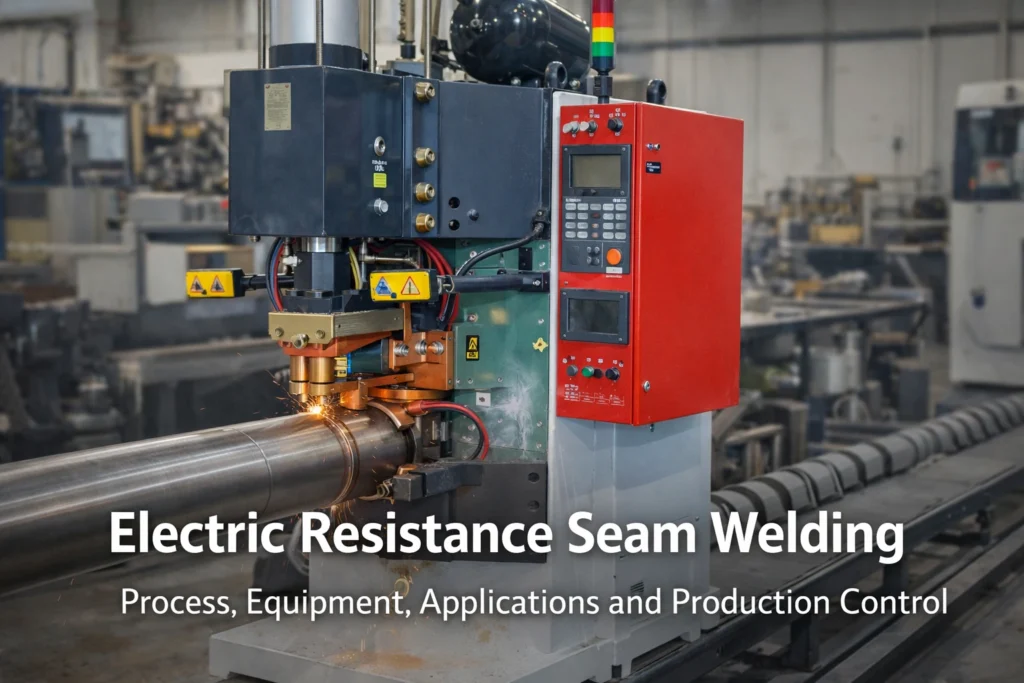
Electric resistance welding (ERW) has become a cornerstone in modern manufacturing, providing precision, efficiency, and repeatable quality in joining metal components. For OEMs, manufacturing engineers, and automation integrators, understanding the fundamentals, applications, and best practices of electric resistance welding is essential for optimizing production lines and ensuring structural integrity in components. Heron Welder, a global leader in industrial welding equipment, offers advanced solutions in resistance welding, helping factories achieve high-performance results across multiple industries.
What is Electric Resistance Welding?
Electric resistance welding is a process where heat generated by electrical resistance is used to join two or more metal pieces. Unlike traditional welding methods that rely on external heat sources like torches or lasers, ERW utilizes the metals’ inherent electrical resistance. When a controlled electric current passes through the contact surfaces of the metals, it produces heat, which, combined with applied pressure, forms a strong metallurgical bond.
Key characteristics of electric resistance welding include:
- Localized heat generation at the joint, minimizing distortion.
- Rapid cycle times, making it ideal for high-volume production.
- Precision and repeatability, suitable for automated manufacturing lines.
Types of Electric Resistance Welding
Heron Welder provides a comprehensive portfolio of resistance welding technologies to meet diverse industrial requirements:
1. Spot Welding
Spot welding is one of the most common ERW methods, ideal for joining sheet metal in automotive, appliance, and metal furniture production. Electrodes apply pressure and electric current at discrete points, creating a weld nugget that holds materials securely.
2. Projection Welding
Projection welding concentrates current at pre-formed projections on one of the metal parts, ensuring consistent heat generation and weld formation. This method is often used for fasteners, brackets, and complex assemblies.
3. Seam Welding
Seam welding is used for creating continuous welds along overlapping metal sheets, such as fuel tanks, pipes, and cans. The rotating wheel electrodes allow for smooth, leak-proof joints.
4. MFDC and Capacitor Discharge Welding
Medium Frequency Direct Current (MFDC) and Capacitor Discharge (CD) welding are advanced ERW methods suitable for precision components, including electrical contacts and microassemblies. These techniques enable extremely fast welds with minimal heat-affected zones.
Applications of Electric Resistance Welding
Electric resistance welding is widely applied across industries where metal joining precision, consistency, and speed are critical:
- Automotive manufacturing: Sheet metal assembly, battery packs, chassis components.
- Aerospace and defense: Lightweight structural panels and precision assemblies.
- Electrical and electronics: Connectors, busbars, and laminated steel cores.
- Industrial machinery: Brackets, fasteners, and machine components.
- Consumer appliances: Washing machines, refrigerators, and metal furniture production.
By integrating ERW into automated production lines, factories can reduce labor costs, minimize defects, and achieve higher throughput, aligning with lean manufacturing principles.
Electric Resistance Welding vs. Other Welding Methods
Compared to traditional fusion welding or arc welding, electric resistance welding offers several advantages:
| Feature | ERW | Arc/Fusion Welding |
|---|---|---|
| Heat source | Electrical resistance | External arc or flame |
| Speed | Very fast cycles | Slower, manual-intensive |
| Distortion | Minimal | Often higher due to heat spread |
| Automation | Easily automated | Automation possible but complex |
| Material thickness | Best for thin to medium | Suitable for all thicknesses |
| Repeatability | High | Variable depending on operator skill |
While ERW excels in high-volume and precision applications, thicker materials or highly dissimilar metals may require alternative methods.
Best Practices for Electric Resistance Welding
To maximize performance and quality in ERW, manufacturers should follow these guidelines:
- Surface preparation: Clean and aligned metal surfaces ensure consistent resistance and strong welds.
- Electrode maintenance: Proper electrode shaping, alignment, and wear monitoring reduce defects.
- Parameter optimization: Correct current, pressure, and weld time are critical for weld strength.
- Automation integration: Using controllers and welding guns designed for ERW ensures reproducibility and minimal operator intervention.
- Quality inspection: Regular monitoring with non-destructive testing or weld sampling maintains production standards.
Heron Welder provides advanced control systems and automated solutions that help engineers fine-tune welding parameters and integrate ERW seamlessly into production lines.
Why Choose Heron Welder for Electric Resistance Welding
Heron Welder has decades of expertise delivering resistance welding machines and automated welding solutions globally. By partnering with Heron, manufacturers gain access to:
- Customized welding machines tailored for specific production requirements.
- Automation-ready systems for high-volume industrial applications.
- Advanced controllers and welding guns for precise parameter management.
- Expert technical support for machine integration, maintenance, and optimization.
Whether it’s spot, projection, seam, or specialized MFDC/CD welding, Heron Welder ensures each solution delivers efficiency, reliability, and repeatable quality.
FAQs About Electric Resistance Welding
1. What metals can be joined using ERW?
ERW works best with steels, stainless steel, aluminum, and copper alloys. Proper parameter adjustment ensures high-quality welds across different metals.
2. Can ERW be automated for high-volume production?
Yes. ERW is inherently suited for automation, with systems capable of precise, repeatable weld cycles integrated into robotic production lines.
3. How does electrode wear affect weld quality?
Electrode wear can reduce contact efficiency and weld consistency. Regular maintenance and monitoring are essential for high-quality results.
4. Is ERW suitable for thick metal components?
ERW is most effective for thin to medium-gauge metals. Very thick materials may require alternative welding methods.
5. What industries benefit most from ERW?
Automotive, aerospace, electronics, appliances, and industrial machinery industries gain the greatest efficiency, precision, and cost benefits from ERW.
Conclusion: Elevate Manufacturing with Heron’s Electric Resistance Welding Solutions
Electric resistance welding offers unmatched speed, precision, and repeatability for modern manufacturing. By choosing Heron Welder, factories can integrate advanced ERW machines, controllers, and automated systems to optimize production, reduce defects, and maintain consistent quality across high-volume operations.
Ready to upgrade your welding processes? Contact Heron Welder today to request a quote or consult with our experts for customized electric resistance welding solutions designed to maximize efficiency and reliability in your production line.

